ESC

What are you looking for?

ESC

What are you looking for?

Shopping cart

Your favorites

You have not yet added any recipe to your favorites list.

Browse recipes

Schedule your 15-minute demo now

We’ll tailor your demo to your immediate needs and answer all your questions. Get ready to see how it works!

0
0
×

School E-Shop

Teaching Children to Save Water

Water is one of the most critical resources for life, learning, and school operations—yet it is often taken for granted. As communities face rising concerns about water scarcity, schools have a powerful opportunity to equip children with lifelong water-saving habits. When water conservation is taught early and reinforced daily, it becomes a natural part of how children think, act, and influence others.

Integrating water conservation into the curriculum doesn’t require a separate subject. It can be woven into science, social studies, mathematics, and even art. For example, students can track their daily water use at home and in school, graph the results in math class, and discuss patterns in science. Simple activities like drawing posters, writing slogans, or creating water-cycle art projects help make abstract ideas relatable and memorable.

Hands-on experiments are especially impactful. Measuring how much water a dripping tap wastes in a day or a week quickly turns “just a few drops” into litres lost. Students see, in real numbers, why fixing leaks and turning off taps matters. This builds not just knowledge, but a sense of urgency and responsibility.

Linking classroom learning to real-life situations strengthens the message. Teachers can discuss how closing taps while brushing teeth, using buckets instead of running hoses, or choosing water-efficient appliances all reduce water bills and conserve local resources. Conversations can then expand to global challenges such as droughts, groundwater depletion, and unequal access to safe drinking water, helping students understand their role in a larger environmental picture.

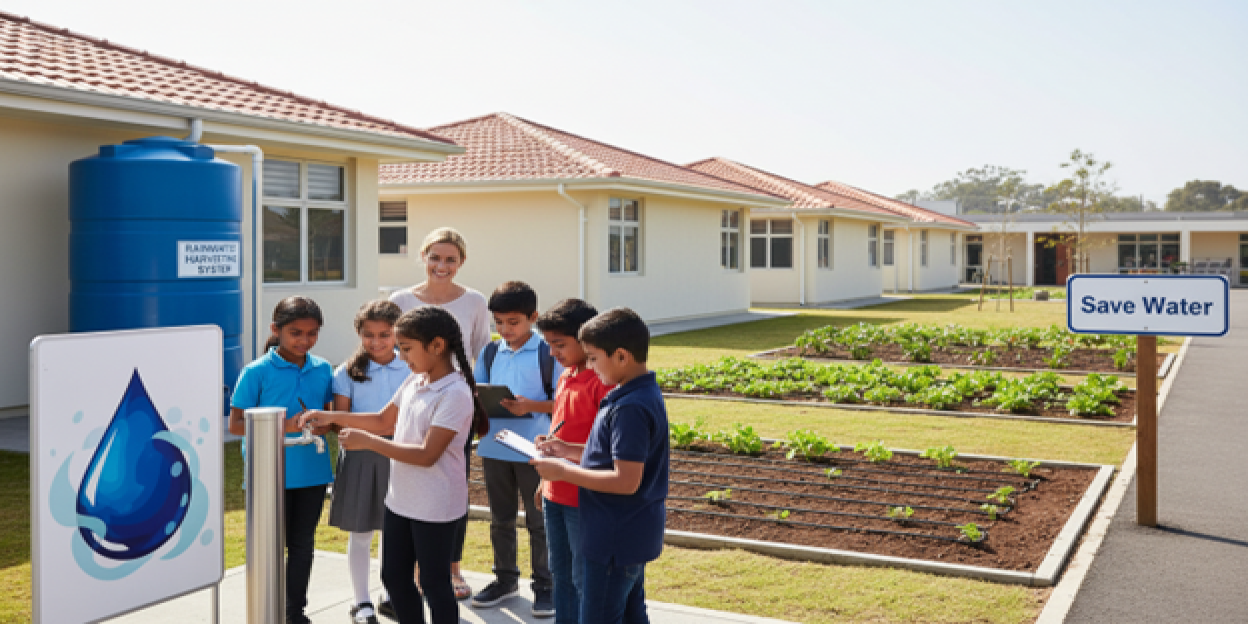
Empowering students to lead change within the school makes conservation personal and visible. Eco-clubs or green committees can run awareness campaigns, design posters, and conduct simple “water audits” of washrooms, drinking water points, and garden areas. When students identify leaks, suggest improvements, and see action taken, they experience the impact of their voice and effort.

To ensure these efforts last, water conservation must be part of the school’s culture, not just a one-time project. Celebrating World Water Day, inviting local environmental experts for talks, or organizing visits to water treatment plants and reservoirs all deepen understanding. At the same time, the campus should model the behaviors being taught: installing water-efficient fixtures, maintaining gardens with native plants, and, where possible, implementing rainwater harvesting systems.

When schools consistently teach, model, and celebrate smart water use, students carry these habits into their homes and communities. Over time, this creates a ripple effect—families become more mindful, local water use improves, and children grow into adults who value and protect this essential resource. By investing in water conservation education today, schools are actively shaping a more sustainable, water-secure future for everyone.

Prev Article
Creating Safe, Inclusive, and Emergency-Ready School Hostels
Next Article
Low-Cost Water Conservation Strategies Every School Can Implement

Related to this topic:

rocket-icon rocket-icon rocket-icon

Learn What Makes Schools Truly Safe

Receive safety guides, policy updates, and best practices from global experts.

We care about your Personnel Data. Please check Privacy Policy